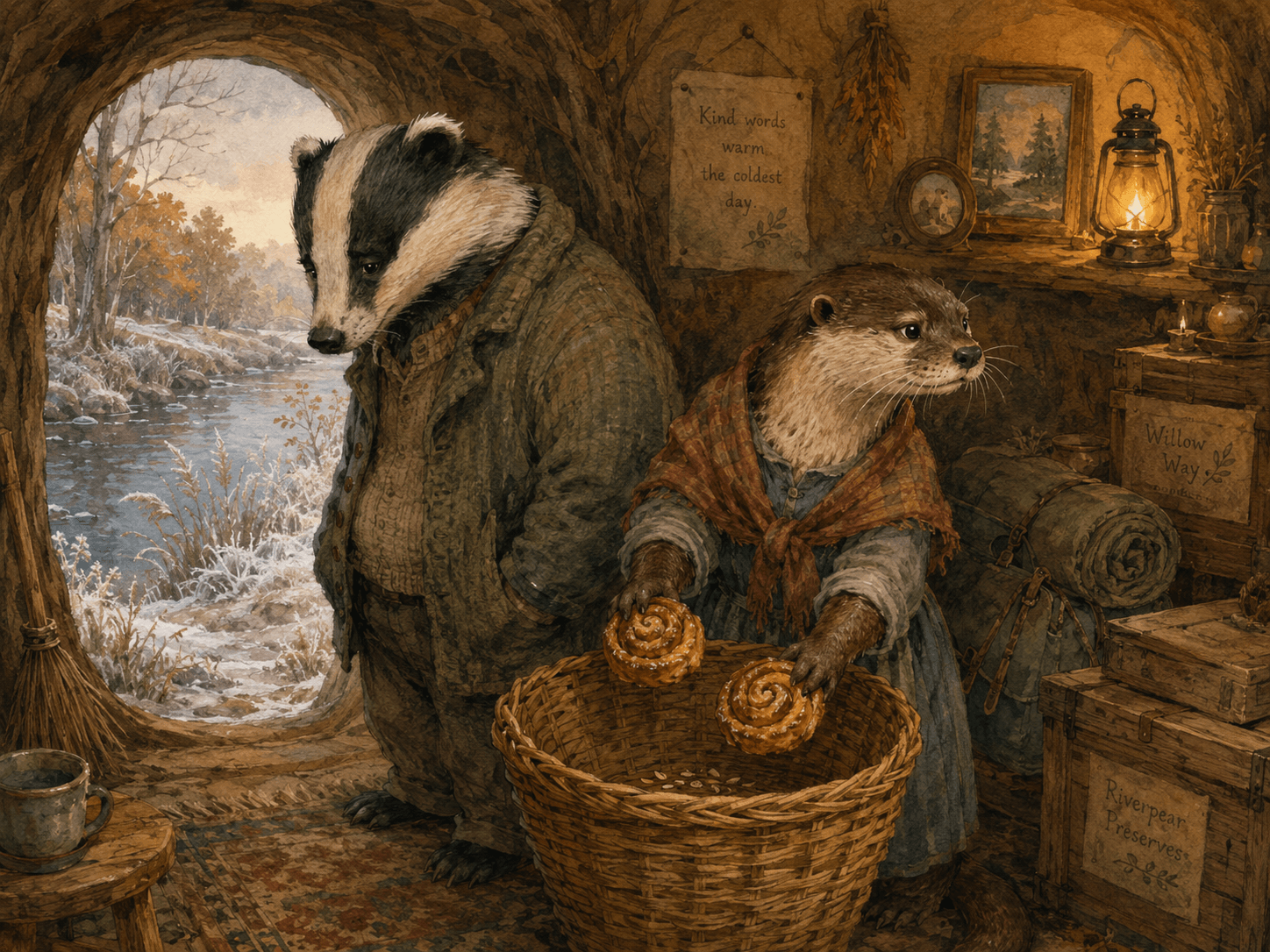
All summer, Badger had watched the river climb toward his sister’s low burrow.
When the first wall collapsed, he paid the crows who held her winter notes. He hired a wagon, gathered her trunks, and hauled them through two valleys. He stacked her belongings beneath his own dry roof and gave her and her little one the warm room beside the stove.
“You may stay until your feet are beneath you again,” he said.
Otter embraced him.
She was grateful. Badger knew this because she said so often, and because gratitude made her restless.
On the third morning, she returned from the market carrying a basket of sugared berries.
“For everyone,” she said brightly.
Badger looked inside. The berries were soft, and no one in his lodge much cared for them.
“They cost six seeds,” she added.
He thought of the crows’ ledger folded in his drawer.
The following week she brought sweetroot biscuits. After that came two cinnamon spirals wrapped in waxed leaves.
“Something small,” she said. “For all you have done.”
Badger placed the spirals on the table.
He did not want to sound unkind. He knew that receiving without giving made Otter feel small. Yet every seed she spent proving she was not a burden delayed the day she would no longer need to be carried.
“You need not bring us treats,” he said. “Keep your seeds.”
Her whiskers lowered.
“I am allowed to do something nice.”
“Of course.”
But the next morning, Badger began noticing other leaks.
Otter paid twelve seeds each moon to keep an old river cart whose axle leaned like a broken leg. She paid ten more to two messenger thrushes, though the lodge already kept four thrushes for less. Her traveling papers had expired, but she postponed renewing them because the questions were troublesome.
Badger had crossed these rivers before. He knew where careless choices became expensive ones.
So he warned her.
About the cart.
About the thrushes.
About the papers.
About the next small purchase.
At first Otter listened. Then she sighed. Soon she began stiffening whenever Badger entered the room.
“You count every seed I touch,” she said one evening.
“I am trying to keep you from losing more.”
“You are trying to manage me.”
Badger’s mouth opened, then closed.
Outside, rain tapped the lodge roof. A drop slipped through a seam and fell into the reed basket between them.
Otter placed another cinnamon spiral inside.
Badger stared at the drop darkening the reeds.
“You keep placing flowers on the bucket,” he said, “while I am trying to mend the leak.”
“And you keep taking the bucket from my hands.”
The lodge grew quiet.
Badger had believed that because he could see the dangerous bends in the river, love required him to call out every stone. Yet Otter had begun to hear his wisdom as proof that she could not be trusted with her own feet.
He sat across from her.
“I will not count every seed,” he said. “Your purse must remain yours.”
Otter looked relieved, but Badger continued.
“My store must remain mine as well. I will give you shelter. I will honor the debts I have already taken upon myself. But I will not replace what is lost to comforts, old carts, or avoidable fees.”
Her eyes filled.
“So I am on my own?”
“No,” Badger said. “But being loved is not the same as being rescued from every choice.”
Otter looked down at the basket.
For a long while, neither of them spoke.
The next morning, she carried the cinnamon spirals back to the market. They were too old to return, so the merchant gave her nothing.
She came home empty-handed.
Badger did not tell her that he had warned her.
He moved the reed basket beneath the leaking seam and handed her a strip of bark for patching the roof.
Otter climbed the stool herself.
When the next drop fell, it struck the bottom of the basket.
No sweets softened its sound.
But no one reached to take the bark from her hands.